A weekend trip to Canterbury and Dover (in Kent, England) will make any history-fan happy! These historic towns have been built up since the Roman times and have castles, cathedrals and gorgeous buildings galore!
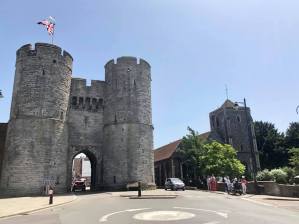 I started with a quick train ride down to Canterbury and entered through the West Gate. Rebuilt in 1380, this medieval gatehouse is 60-feet high and is the largest surviving city gate in England. It was originally part of the walls that circled the entire city, as Canterbury was walled by the Romans around 300 AD. After entering through the gate, you are met with street after street of lovely old pubs, shops and hotels.


One particular highlight is the Marlowe Theatre. The theater was named after the playwright Christopher Marlowe, who was born and attended school in the city. Just outside of the theater is the The Muse of Poetry (Marlowe is known as the Muses’ darling) surrounded by small effigies of characters from Marlowe’s plays.


Perhaps the most iconic site in Canterbury is the Canterbury Cathedral, the seat of the Archbishop of Canterbury (spiritual head of the church of England for 500 years) and 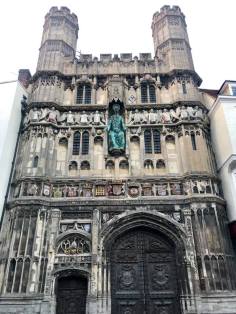 also the site of St. Thomas Becket’s brutal murder, ordered in 1170 by King Henry II. What not everyone realizes is that Canterbury is actually a UNESCO World Heritage site because of not only Canterbury Cathedral, but also the two other sites – the Church of St. Martin and the ruins of St. Augustine’s Abbey. Don’t worry, I saw all three! They all reflect significant milestones in the history of British Christianity.
The Church of St. Martin is the oldest church in England. St. Martin’s was originally the private chapel of Queen Bertha of Kent (died in or after 601) in the 6th century before Saint Augustine of Canterbury arrived from Rome in 597. Queen Bertha was a Christian princess who arrived in England to marry a pagan, King Ethelberht of Kent. He built the St. Martin’s church for her in 580.


Shortly after, St Augustine, the first Archbishop of Canterbury, arrived on the coast of Kent as a missionary to England in 597AD. He came from Rome, sent by Pope Gregory the Great. upon Augustine’s arrival (AD 597), he used St Martin’s as his mission headquarters. King Ethelberht was soon baptized here. With that, “ the great abbey” was build marking, the rebirth of Christianity in southern England. The abbey was founded in 598 and functioned as a monastery until its dissolution in 1538 during the English Reformation.
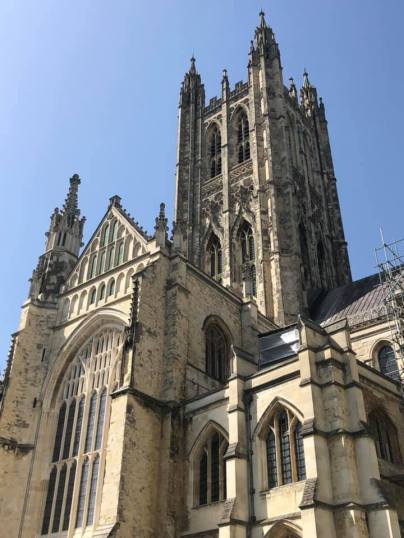 The Canterbury Cathedral is often described as “England in stone”. From its first Archbishop, Augustine, who established Christianity in England to Archbishop Langton’s role in the Magna Carta negotiations and the power struggle between King Henry II and Archbishop Thomas Becket, Canterbury Cathedral’s history is as rich as it comes. With the collapse of Roman rule and the invasions of Angles, Saxons and Jutes in the fifth century, the old capital of the Roman province of Cantium fell into ruins. It was revived in 597, when Augustine established his throne (in Latin “cathedra”) in a derelict Roman church within the old city. Canterbury Cathedral has remained the capital of English Christianity from that day to this. Augustine’s original building lies beneath the floor of the Nave – it was extensively rebuilt and enlarged by the Saxons, and the Cathedral was rebuilt completely by the Normans in 1070 following a major fire. There have been many additions to the building over the last nine hundred years, but parts of the Quire and some of the windows and their stained glass date from the 12th century. By 1077, Archbishop Lanfranc had rebuilt it as a Norman church, described as “nearly perfect”.


Canterbury’s role as one of the world’s most important pilgrimage centers in Europe is linked to the murder of its most famous Archbishop, Thomas Becket, in 1170. When, after a long lasting dispute, King Henry II is said to have exclaimed “Who will rid me of this turbulent priest?”, four knights set off for Canterbury and murdered Thomas in his own cathedral. A sword stroke was so violent that it sliced the crown off his skull and shattered the blade’s tip on the pavement. The murder took place in what is now known as The Martyrdom (memorialized in the places shown in photos).


In addition to these three famous and historic churches, there is also the ruins of a 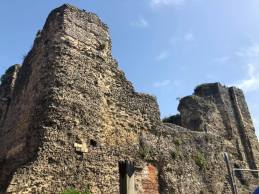 norman Castle. Canterbury Castle was one of the three original Royal castles of Kent (the other two being Rochester Castle and Dover Castle). They were all built soon after the Battle of Hastings, on the main Roman road from Dover to London. This was the route taken by William the Conqueror in October 1066, and they were built to guard this important route.
Along with the white cliffs, we saw the second norman Castle – Dover Castle – after just a short 15 minute train ride. This was perhaps the most spectacular castle and  surrounding grounds we have explored in our travels thus far.
Immediately after his victory at Hastings in 1066, William the Conqueror strengthened the defenses with an castle. From then on Dover Castle was garrisoned without interruption until 1958, including critical use in both WWI and WWII as a naval base and command center.
In the 1180s Henry II remodeled the castle, planning its great tower. It is 83 feet high and has three floors of rooms with the topmost being state apartments for the king himself. He designed this impressive castle to 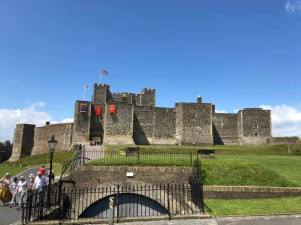 demonstrate power and welcome and impress distinguished visitors to England – particularly noble pilgrims travelling to the new shrine in Canterbury Cathedral of Thomas Becket. The archbishop was slaughtered in front of the altar there by Henry’s household knights in 1170, ten years before the great tower was begun. He used this new castle to repair his reputation after the questionable death and his involvement…on the second floor of the great tower is a chapel dedicated to Becket, with richly decorated stonework.
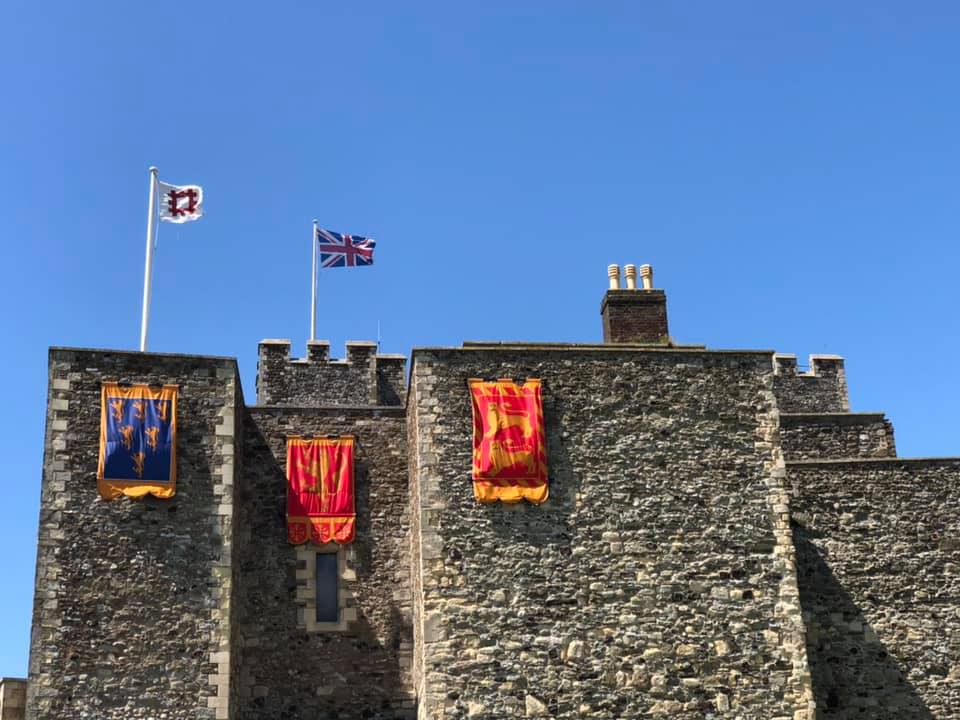
Prior to King Henry II’s castle here in the 1180s, The Romans built a lighthouse – one of  the best-preserved in Europe – on the heights here after they invaded in AD 43, to guide ships into the harbour. The Anglo-Saxon church, St Maria in Castro, beside the lighthouse was once probably part of a Saxon fortified settlement, around the same very early timeframe. These were amazing to see!!
By 1905 advances in technology made it possible for coastal artillery around the harbor to be controlled from a central Fire Command Post built on the cliff edge. Its commanding position led the Admiralty to put their naval signal station on top of it in 1914, from which the Navy controlled the movement of all ships in and out of the harbor. The Napoleonic tunnels were brought back into service in the Second World War, when they made their most notable contribution to British history. From 1939 they housed the command center that controlled naval operations in the Channel. Over the next few years the tunnels were greatly extended to serve as both a hospital and a large combined headquarters, responsible for guarding the Straits of Dover and involved in preparing for the 1944 invasion of Europe. Later, during the Cold War, this network of tunnels was transformed into the secret location of one of Britain’s Regional Seats of Government, with the role of organizing life in the event of a nuclear attack.
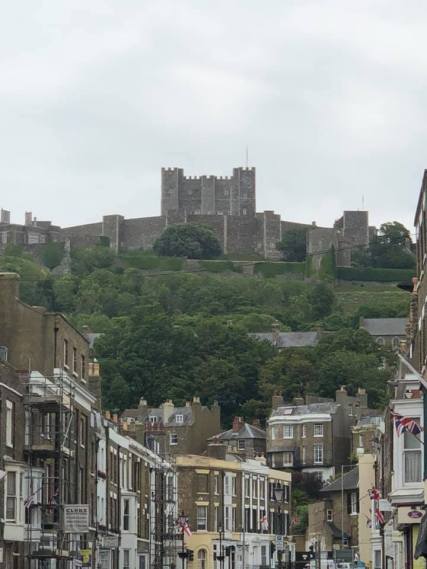
From 43AD to today, these gorgeous castles and cathedrals play a huge role in religious, cultural and military history. An incredible weekend trip!!
– MAL
Hotel:
- Cathedral Gate Hotel – central location, in a building from the 1300s, old but lots of charm/clean/comfy
Restaurants:
- Café De Amis
- Unicorn Inn
- The White Horse Inn
Sites:
- Canterbury Cathedral
- Canterbury Castle
- West Gate
- St. Augustine Abbey
- St. Martin’s Church
- White Cliff of Dover
- Dover Waterfront
- Dover Castle
 Travel with MAL