It was truly and honor to visit Normandy and explore the historic D-Day sites and beautiful French countryside. Just a few hours outside of Paris, this is definitely well-worth a day trip in your Parisian vacation.
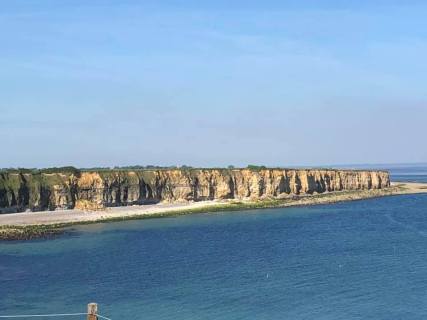
I opted for a semi-privat tour, so it was a group of 6. We began the (very early) morning with our first stop at Pointe De Hoc. This 100-foot cliff overlooking the English Channel was the highest point between the American sector landings at Utah Beach to the west and Omaha Beach to the east. On D-Day, the United 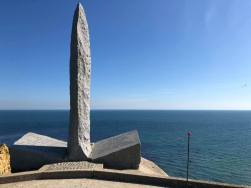 States Army Rangers began attacks and captured Pointe du Hoc after scaling the cliffs. The German army fortified the area with concrete bunkers and gun pits and we got to go into the old bunkers and saw many deep craters where the air raid bombs were dropped. Pointe du Hoc now features a memorial, erected by Ronald Reagan, to commemorate the Rangers.


From there, we proceeded east to Omaha Beach, the largest of the US Beach assault locations on D-Day. You can see that the terrain is challenging for an amphibious assault because of the low tide and high cliffs surrounding the area.

Just to the northeast, overlooking the beach is now the dedicated American cemetery. The Normandy American Cemetery and Memorial is actually located on the site of the temporary American St. Laurent Cemetery, established on June 8, 1944 as the first American cemetery on European soil in World War II. The cemetery covers 172.5 acres and contains the graves of more than 9,380 of our military dead, most of whom lost their lives in the D-Day landings.
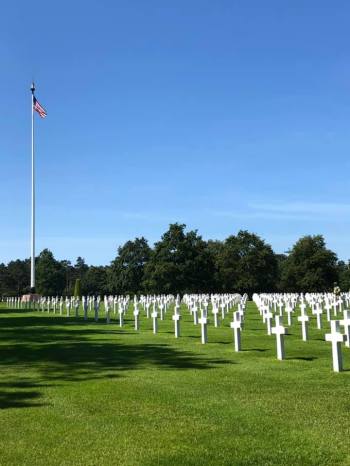
Prominent features include:
- The Walls of the Missing, in a semicircular garden on the east side of the memorial, are inscribed 1,557 names.
- A semicircular colonnade with a loggia at each end containing large maps and narratives of the military operations
- The bronze statue, “Spirit of American Youth Rising from the Waves.”
- Reflecting Pool – Facing west at the memorial, one sees in the foreground the reflecting pool; beyond is the burial area with a
- Circular Chapel surrounded by granite statues representing the United States and France.


The site is very moving, much like Arlington National Cemetery outside of Washington DC.
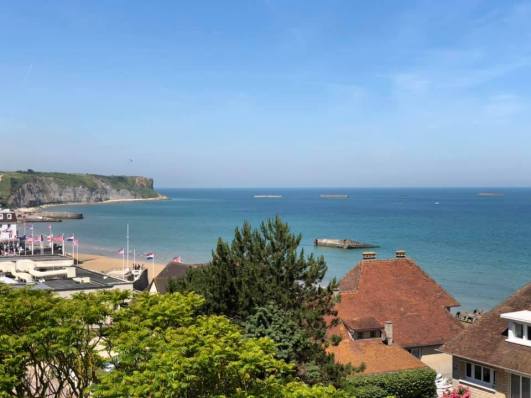
The next stop was the Gold Beach at Arromanches, one of the two British landing zones on D-Day. At this site, it was very interesting to see the floating harbor created by Winston Churchill to bring in Allied supplies (including an oil pipeline) from England. To create these, they sunk decommissioned ships (116 in total) and connected them with floating metal structures to create a five-mile-long arc. The harbor at Gold Beach was used for 10 months after D-Day and over 2.5 million men, 500,000 vehicles, and 4 million tons of supplies were landed through this structure!


Our final D-Day site was to view the final landing zones – Juno Beach and Sword Beach. Juno Beach was the site of the Canadian landing and Sword was the secondary British landing zone.
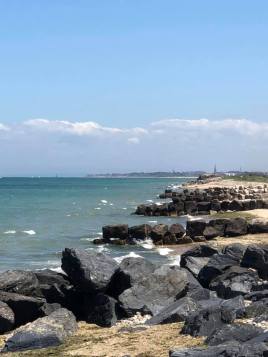
We finished the day with a lunch in the French countryside. This is one of my favorite days of our travels so far – it was incredible to see the site I’ve studied about for years!
-MAL
 Travel with MAL
Loved this, MA! It’s incredible what these brave men did for our country & truly for all of mankind.
LikeLike